Five ways comprehensible input comes alive in the classroom — what we actually do, and why each approach builds real language.
Students build lasting proficiency when understandable language, meaningful choice, and inclusive support work together — comprehension comes first, and confident production follows.
From my teaching philosophy
Tabula I · A day in the room
What a typical class looks like
Before the individual techniques, here's how they fit together in a single 45-minute lesson — the rhythm students settle into every day.
I
Warm-up in Latin (5 min)
We open with a quick spoken exchange — the date, the weather, how everyone's doing — entirely in Latin. It resets ears to the language before anything new arrives.
II
Circling a new structure (10 min)
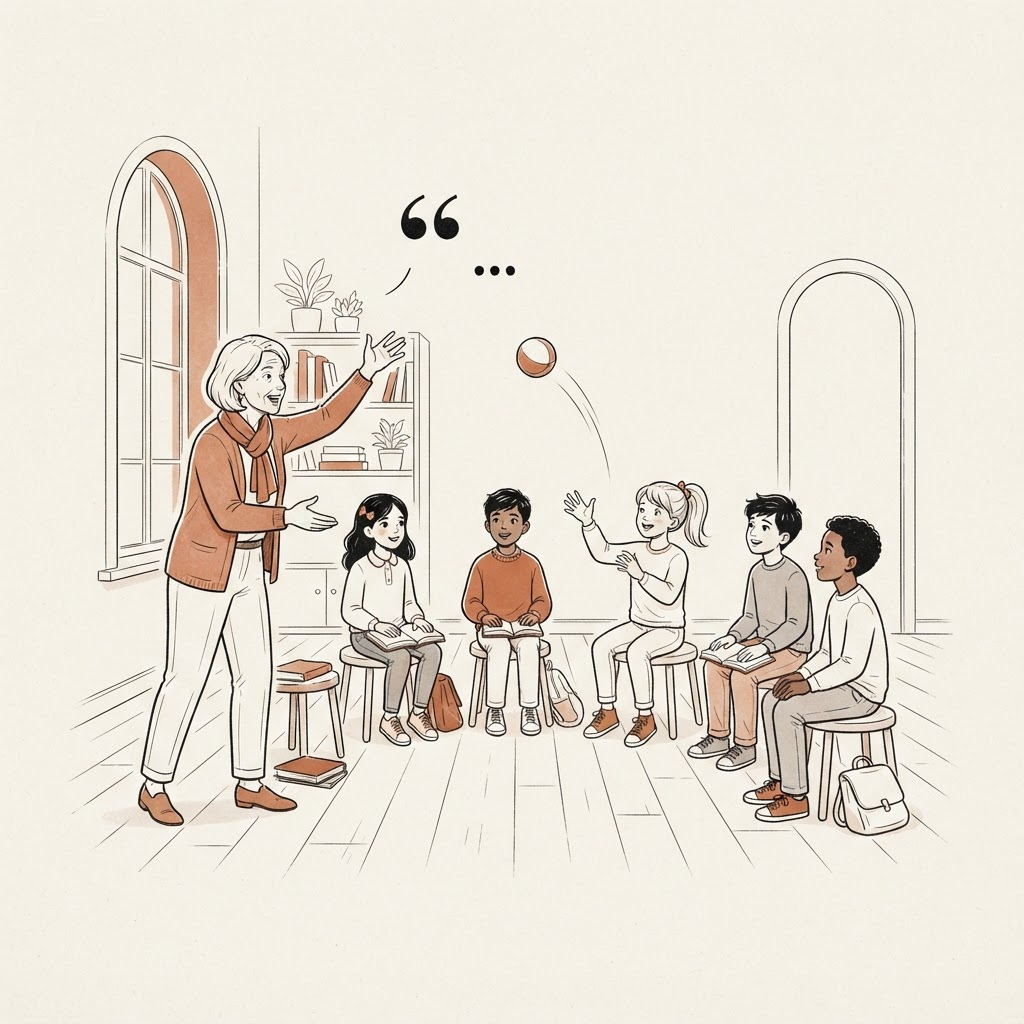
I introduce two or three new phrases and 'circle' them: asking the same idea many ways, tossing a soft ball to keep everyone alert, until the meaning is rock-solid for the whole room.
III
A story, acted out (15 min)
We build or read a short story using those structures. Volunteers act it out — a reluctant Caesar, a talking dog — while the class supplies details. Grammar gets noticed, never lectured.
IV
Read and respond (10 min)
Students read a version of the story on the page, then show understanding by drawing it, retelling it, or answering comprehension questions — meaning first, always.
V
Free voluntary reading (5 min)
We close with quiet reading from the class library — each student with a novella at their own level. This is where independent fluency quietly takes root.
Tabula II · The techniques
Five ways CI comes alive
Each piece of that rhythm rests on a specific method. Here's what we do and why it builds real language.
Storytelling & Acting
What we do
Students act out Roman myths, historical events, and original class stories, bringing figures like Caesar, Cicero, and mythological characters to life.
Why it works
Language acquisition happens naturally when students are engaged in meaningful, compelling narratives — grammar and vocabulary emerge through context.
Try it in the room
The class decides why a reluctant Caesar cannot cross a tiny river; volunteers act while Magistra retells and checks meaning.
What you can observe
Students follow and retell a complete narrative using recurring language in context.
Movement-Based Learning
What we do
TPR (Total Physical Response) for vocabulary acquisition
Gesture-based grammar instruction
"Roman soldier marches" while learning military terminology
Classroom movement games that reinforce concepts
Why it works
Physical movement enhances memory retention and keeps kinesthetic learners engaged — especially beneficial for ADHD and other neurodiverse learners who need physical outlets.
Try it in the room
Students respond to a short sequence of commands, then direct a partner through the same actions.
What you can observe
Students demonstrate understanding before they are asked to produce unfamiliar language.
Interactive Games & Activities
What we do
Circling with balls — students answer comprehension questions with soft balls to keep everyone alert
Character interviews — students become Roman historical figures
Cultural simulations — Roman banquets, gladiator schools, Senate debates
Comprehension races between teams
Why it works
Games lower anxiety, increase engagement, and make repetition enjoyable rather than tedious.
Try it in the room
Teams hear a description, identify the matching character or scene, and explain the clue that led them there.
What you can observe
Repeated comprehension practice stays purposeful, social, and low-pressure.
Comprehensible Reading Program
What we do
Read adapted Latin novellas as a class
Create original class stories based on student interests
Focus on meaning-making rather than translation
Progress gradually from heavily supported to independent reading
Why it works
Reading for comprehension, not translation, builds genuine language proficiency and cultural knowledge.
Try it in the room
Students read a familiar story, sketch its turning point, and cite the Latin detail that supports their interpretation.
What you can observe
Students read for meaning and support an interpretation without translating every line.
Cultural Integration Projects
What we do
Design Roman villa floor plans with Latin labels
Create authentic Roman feast menus
Research and present on Roman daily life and history
Connect Latin vocabulary to modern derivatives
Why it works
Culture and language are inseparable — understanding Roman culture makes vocabulary and concepts more memorable.
Try it in the room
Students design a Roman feast menu, label it in Latin, and explain choices through evidence about daily life.
What you can observe
Students connect language to a culturally grounded product and explain the thinking behind it.
Tabula III · Assessment
Assessment philosophy
I
Comprehension-based
Tests focus on understanding, not perfect production. Students demonstrate comprehension through various modalities.
II
Growth-oriented
Progress tracking emphasizes individual growth rather than comparison to others.
III
Low-stress
Assessment methods are designed to show what students CAN do, not what they can't.
Tabula IV · Take it with you
Practical guides
Use these concise originals as a student-facing companion or a teacher-facing overview of the classroom structures above.
Original PDF · 1 page
How to Study Latin
Four practical habits for reading, rereading, speaking, and asking for help before a small gap grows.